AI Agents, Agentic AI, and Generative AI: A Clear Map of the 2026 Landscape
Generative AI, an AI agent, and agentic AI are three different things — and most teams ship the wrong one because they never drew the line. A plain-language map of what each actually is, how they stack, and how to pick the right altitude for the job. With diagrams, no hype.
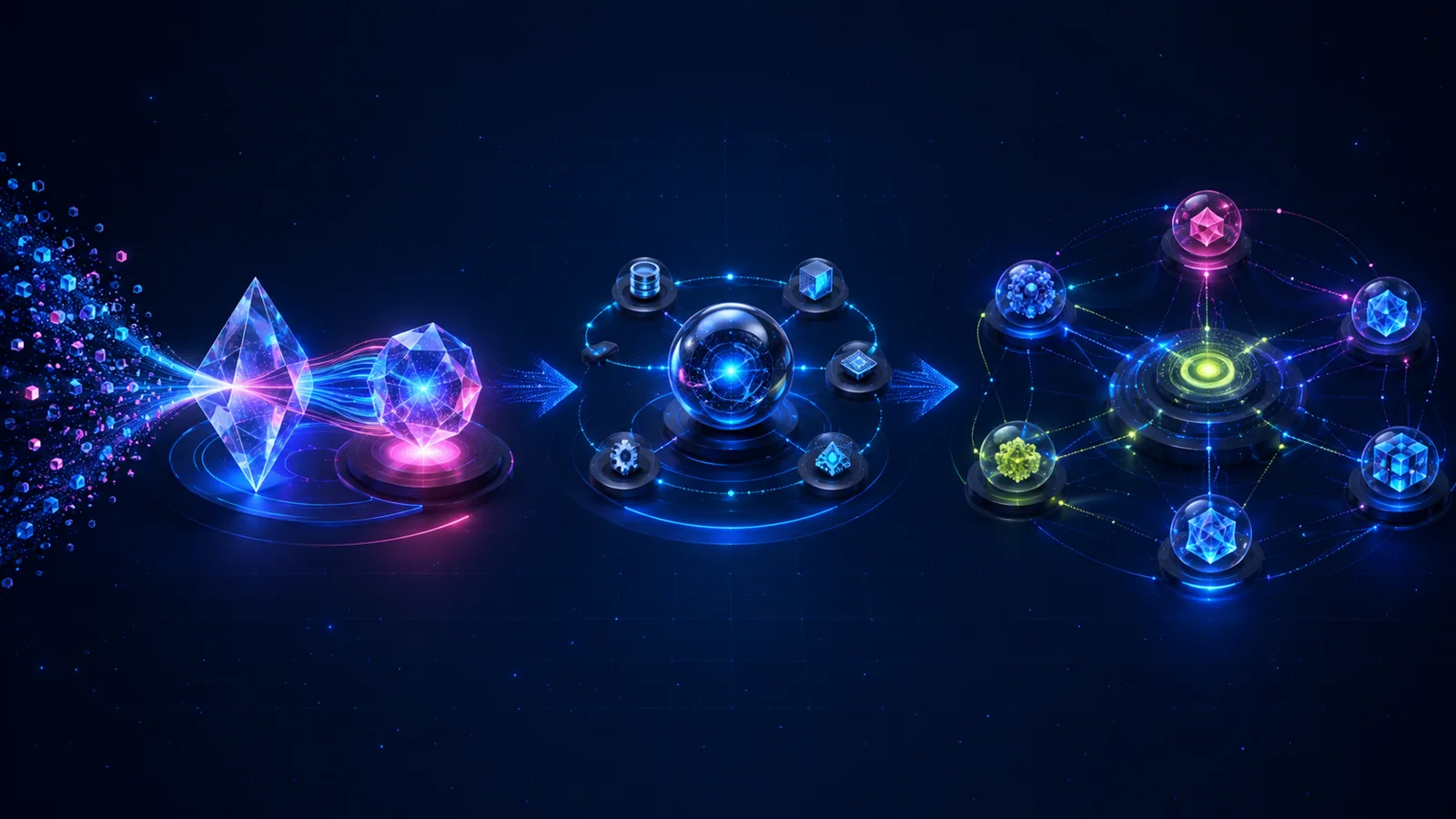
A client asked me last month to "build an AI agent" for their support desk. After twenty minutes of questions, what they actually needed was a single well-prompted summarization call wired to a template. No agent. No tools. No loop. The word had become a stand-in for "make it smart" — and that confusion was about to cost them three months of engineering they didn't need.
This is the most expensive misunderstanding in applied AI right now. Generative AI, an AI agent, and agentic AI are not synonyms, and they are not interchangeable. They sit at different altitudes, carry different costs, and fail in different ways. Pick the wrong one and you either over-engineer a problem that wanted one API call, or you ship a chatbot to do a job that genuinely needed autonomy.
This guide draws the lines clearly — with definitions you can act on, a layered mental model, and an honest decision guide. No hype, no "AGI is here" framing. Just the map I wish every team had before they started building.
The whole landscape in one picture
Before the definitions, here is how the three concepts stack. Each layer is built on the one below it. You cannot have an agent without a model; you cannot have agentic behaviour without agents. Read this top to bottom — every section maps to one band.
Generative AI: the model answers, you stay in control
Generative AI is the layer most products actually live at, and the one most people mean when they say "AI" in 2026. You send a prompt, the model returns a completion, and your code decides what happens next. There is no loop the model controls. It generates; you orchestrate.
Summarize a document. Draft an email. Classify a ticket. Extract structured fields from a PDF. Translate. Rewrite. Answer a question from supplied context. Every one of these is a single generative call — input in, output out — and the overwhelming majority of business value from LLMs today comes from exactly this shape.
// Generative AI — one request, one response, you own the flow
const res = await client.messages.create({
  model: "claude-opus-4-8",
  max_tokens: 1024,
  system: "You are a precise support-ticket classifier.",
  messages: [{ role: "user", content: ticketText }],
});
// YOUR code decides what to do with res — route it, store it, reply.
const label = res.content[0].text.trim();The reason this matters: generative calls are cheap, fast, predictable, and easy to test. You can unit-test them, cache them, and reason about their cost. The moment you wrap a model in a loop and hand it tools, you give up most of that predictability. So the engineering discipline is to stay at this layer as long as the problem allows, and climb only when you must.
AI agents: the model decides which actions to take
An AI agent is what you get when you give a model three things it doesn't have on its own: tools (functions it can call — search, a database query, an email sender), memory (state that survives across steps), and a goal instead of a single instruction. Then you put it in a loop and let it decide, at each step, what to do next.
The shift is subtle but total. In generative AI, you write the control flow. In an agent, the model is the control flow. It looks at the goal, picks a tool, reads the result, and decides whether it's done or needs another step. You no longer know in advance how many calls it will make or in what order.
The leading model providers now expose this loop as a first-class feature. With tool use, you describe your functions as JSON schemas, and the model returns structured tool_use requests that your harness executes and feeds back — looping until the model decides it's finished. You can run that loop yourself for full control, or let the SDK's tool-runner drive it. Either way, the defining property is the same: the model, not your code, chooses the next action.
The honest test for whether you need an agent: can you draw the flowchart in advance? If you can — if step 2 always follows step 1 — you don't need an agent, you need a pipeline of generative calls. Agents earn their keep precisely when the steps can't be known ahead of time.
Agentic AI: many steps, many agents, over time
If an agent is a single worker with tools and a goal, agentic AI is the organisation. It is the band where you have either one agent operating over a long horizon — dozens or hundreds of steps, persisting memory across sessions, recovering from its own mistakes — or, more often, several specialised agents coordinating: a planner that breaks down the work, workers that execute pieces in parallel, a critic that checks the output, an orchestrator that routes between them.
This is the frontier, and it is where the genuinely impressive demos live: an agent that takes a vague design doc and opens a working pull request, a research system that runs for fifteen minutes across many sources and returns a cited report, a multi-agent pipeline that drafts, reviews, and revises a financial model until it passes a rubric. The newest frontier models are specifically trained for this long-horizon, autonomous work — single requests on hard tasks can run for many minutes of continuous reasoning and tool use.
Here is the part the demos don't show you: agentic systems are hard to make reliable. Every extra step is another chance to go off the rails. Errors compound. Costs multiply — a single long-horizon run can spend more tokens than thousands of generative calls. And debugging a non-deterministic system of agents that took a different path every run is a genuinely new engineering discipline. The teams shipping agentic AI successfully treat it less like "calling an API" and more like "managing an unreliable junior team": clear goals, tight feedback loops, verification at every boundary, and a human who can step in.
The autonomy ladder — and where to stand
The cleanest way to hold all of this in your head is as a ladder of autonomy. The higher you climb, the more the system decides for itself — and the more capability, cost, latency, and risk you take on together. They move as one.
| Rung | Who controls the flow | Good for | The cost |
|---|---|---|---|
| Generative | Your code | Summaries, extraction, classification, drafting, Q&A over given context | Almost none — fast, cheap, testable |
| Workflow | Your code, with model steps | Multi-step pipelines where you know the steps (e.g. extract → validate → format) | Low — still deterministic |
| Single agent | The model, in a loop | Open-ended tasks where the steps can't be known ahead of time | Medium — non-deterministic, harder to test |
| Agentic | Multiple agents / long horizon | Complex, high-value outcomes worth the latency and spend | High — error compounding, cost, hard debugging |
How to actually decide
When a new use case lands on your desk, walk these questions in order. The first "no" tells you where to stand.
- Can I write the answer as one input → output transformation? If yes — stop. Generative AI. A summarizer does not need a loop.
- Can I draw the full flowchart in advance? If yes, build a workflow: a fixed pipeline of generative calls and code, where you own every branch. Predictable and debuggable.
- Do the steps genuinely depend on what the model discovers along the way? Now an agent earns its place. Give it tools, a clear goal, and tight guardrails.
- Is the outcome valuable enough to justify a system of agents running for minutes, sometimes failing, and costing real money? Only then climb to agentic. And when you do, verify everything.
Notice the bias baked into that list: it pushes you down the ladder, not up. That is deliberate. Autonomy is a cost you pay for capability you actually need — never a default.
The human touch this all still needs
For all the talk of autonomy, the systems that work in production are the ones with a human clearly in the loop at the right moments — approving an irreversible action, reviewing a generated contract, catching the confident-but-wrong answer before it reaches a customer. The goal of good AI engineering is not to remove the human. It is to remove the drudgery around the human and put their attention exactly where judgment matters.
That framing keeps you honest. Generative AI drafts; a person approves. An agent gathers and proposes; a person decides. Agentic AI does the heavy, repetitive coordination; a person owns the outcome. Build at whichever altitude the task needs — and never lose the seam where human judgment plugs back in.
Where to go next
This is the conceptual map. The next three posts in this series go practical: how to build a production-grade RAG system that gives grounded answers instead of confident hallucinations; the tooling you actually need to build agents and RAG without drowning in frameworks; and concrete automation blueprints for support, medical, legal, and finance — showing exactly how RAG and agentic AI run behind the scenes of a simple chat box.
The one-line takeaway: Generative AI answers, an agent acts, agentic AI coordinates. They are rungs on a ladder of autonomy, not a list of buzzwords — and the whole craft is standing on the lowest rung that gets the job done.



Comments (0)
No comments yet
Be the first to share a thought on this article.
Join the conversation